

The Transformative Power of Post Sound
Lily Cunningham Perini and Wren Stark Haven, of Wild Shape Sound, on how to get the most out of your film's sound mix.

Nothing Bogus is funded by its readers. To support this work, please consider upgrading from a free subscription to a paid one. For only $5/month or $50/year, you’ll get access to all content + the sublime high that comes from supporting independent arts journalism. Sharing the newsletter also goes a long way.
What a time to be alive in New York City! When was the last time you felt communal joy like this? On Saturday, when the Knicks wrapped the finals, I was up in Nyack, NY, at my sister’s wedding (congrats to Emmy and Ben!). We projected the game on a big screen that was visible from the dance floor. And then at halftime, we moved to the afterparty at a local hotel, and watched there. I’d been viewing most of the previous games (including the epic Game 4 comeback) at a bar in Crown Heights with friends. I never thought I’d see a Knicks title in James Dolan’s lifetime. And I really never thought I’d see it happen in the lobby of a Nyack hotel, with a bunch of my cousins and my brother-in-law’s camp friends, all of us dressed in suits. But life is full of surprises! And sometimes they’re really great! I’m not going to tie this back to movies. See you at the parade.
Here’s what’s happening this week:
On June 16 at 9:00 PM, join Eddy Frumkin and William George-Louis for the fourth screening of All-Starrs at Starr Bar in Bushwick. They’ll be screening films from Amy Zimmer (Blue Heron), Paul Dallas (The Plagarists and Reality), Kris Lefcoe (Public Domain), Meg Case and Brad Porter with Ryan Czerwonko (Adult Film), 2026 Sundance award winner Arielle Knight, and Genesis Taina Luciano. Tickets are $10. More here.
NYC/Upstate folk horror feature Blood Shine finishes a long festival run this month at Chattanooga Film Festival on June 21st. Directed by Emily Bennett and Justin Brooks, this twisted love story releases later this year. The film stars Brenden Sexton III (Welcome to the Dollhouse, Session 9), David Call (Insidious: The Red Door), Larry Fessenden (Killers of the Flower Moon), Toby Poser (Hellbender) and Bennett herself (Shelby Oaks).
Slamdance screenplay competition deadline is June 22.
I’m putting together an anonymous Distribution Report Card so that filmmakers can get a better sense of other filmmakers’ experience with different distribution companies. As an act of public service, fill out this survey please. To repeat, it will be ANONYMOUS, and you do not have to include any revealing details about your film.
If you live in a city outside of NY/LA, please fill out this survey! Especially if you live in (or have lived in) MIAMI!!!
I would like to try whatever drug all the critics celebrating Disclosure Day are on.
John Early’s excellent debut directorial feature, Maddie’s Secret, is out this week. Friends of the newsletter Harris Mayersohn, Hannah Dweck and Ted Schaefer, and Sarah Winshall all worked on it.
And I enjoyed Honeyjoon last year when I caught it at Tribeca. It’s now playing in NYC at IFC through June 18.
If you would like to list in a future issue, email nothingbogus1@gmail.com with the subject “Listing.” (It’s FREE!) Include your email and all relevant details (price, dates, etc.)
GOOD LISTENING
The Transformative Power of Post Sound
Lily Cunningham Perini and Wren Stark Haven, of Wild Shape Sound, on how to get the most out of your film’s sound mix.
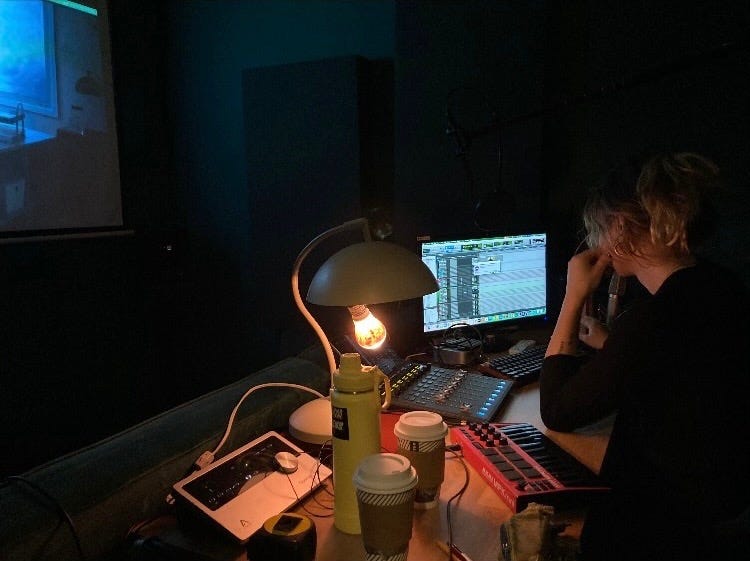
A few years ago, Lily Cunningham Perini was hired as a production mixer on a short film called Junior Associate. She’d done a surround sound mix in Premier for her undergraduate thesis, but had never worked as a production sound mixer. “I was like, ‘Yeah, I can totally do that.’ And then I called my friend and said, ‘Do you know anyone in the city who knows how to do production sound? Because I need to learn it tonight,’” she says. Cunningham Perini’s friend referred her to Wren Stark Haven, who had production experience and also was finishing a graduate film degree at TISCH with a concentration in sound1 at the time. “I had the basics from doing documentary in school, but Wren taught me how to do it professionally,” Cunningham Perini says. “And then a year into working production I got hit up for a short to do post sound. And once again I said yes without knowing how to do it at all. And Wren once again taught me how to use Pro Tools — and literally everything I know about Pro Tools is from Wren.”
In 2023, they joined forces officially, starting Wild Shape Sound, a post studio in Ridgewood. They’ve worked on all manner of projects — including The Scout, Revelations of Divine Love, and The Big Game (which I produced). But whether they’re working on narrative, documentary, or commercials, they’ve developed an ethos that they believe enables the best results. What it boils down to is simple: being a full-service shop, and one where directors are required to spend time in the studio with them. “Our value add on a film is we’re honing in on a unified voice for the film,” says Stark Haven. “It’s more joyful too,” adds Cunningham Perini.
Wren, you’re the only person who’s gotten an MFA in sound from NYU, so A) What drew you to that? And B) What did you learn through that program?
WSH: I have to shout out Dan Timmons, a mentor I met at NYU. He used to teach a class at NYU that I now teach, which is the second year post sound class. I had always been intimidated by post. But seeing Dan use really basic tools to create beautiful things was inspiring because I was like, Oh, I actually know what he’s doing here. So I talked to him during the class, and asked him to do an advanced study with me.
And then where it actually became life’s work shit was when Robin Zeijlon, who was a year below me at NYU, became the first person to hire me to do this. It took off pretty quickly after that. I booked Revelations of the Divine Love, which was like my second film school. Working with Carline Gollum reminded me of the stories you hear about Sidney Lumet being in the mix. He would literally fall asleep during a reel and the re-recording mixer would be like, “Sydney, do you want to hear that again?” And he’d be like, “Eh, I’m sure it’s great.” Caroline just has so much faith and weirdly that makes me want to work harder. That was my first feature as a re-recording mixer. I had been editing for Dan and Jeremy.


Can you describe what editing means where sound is concerned?
WSH: Editing is the process of adding all the sounds you might possibly want to hear in the movie. We have these structures that let that process happen efficiently. We break it up into stems. The common stems are backgrounds, which are sounds that run for the length of a scene or a moment in time; there’s also foley, which are the sounds the characters make interacting with props, footsteps, that sort of stuff. And then the mix is where you start subtracting and curating. The core metaphor is that editing is the creation of a bespoke musical instrument for the film and then mixing is like playing different notes on that instrument.
This process of making something that sounds unified and coherent is very similar to cinematography. And I think what gets lost often is when filmmakers start compartmentalizing sound as this grocery store list of things they’ve got to get and then there’s no unity. That’s what Lily and I have planted our flag in. It’s not just a money thing to be a full service shop. It’s an ethos. Our value add on a film is we’re honing in on a unified voice for the film. You end up really spending more money and having more go around when you buy a dialogue edit from one place and you buy a little foley somewhere else, and then they’ll buy a mixer, and nobody’s talked to each other. Think about if you did cinematography that way. Films would probably look a lot less coherent if you had a camera operator and then a different person choosing the lens, and then a third person picture editing, and another person coloring, but no one is talking to each other.
LCP: A lot of times Wren will rerecord mix and I will do the effects edit, and someone else on our team, if not Wren, will do the dialogue, and we’ll all be in the room together. When you’re actively making the mix of the movie, the director is in the room with you. And we insist that the director’s in the room with us.
WSH: I do think notes via email are poison for your movie. Nobody does their best work that way. It transforms everything when you’re in the same space, hearing the same thing. We can have the same physiological experience. And we’re humans to each other.
LCP: It’s more joyful too. There’s so much trust in the room. It’s the communal experience we want.
Are there certain things you ask directors to arrive with? Do you give homework?
WSH: We ask a lot of questions. We try not to give homework. But the secret homework is we propose a schedule that sounds like they’re buying something, where really we’re kind of getting something. The first step of the process is spotting, which is when you watch the movie.
LCP: That’s our homework that we do together.
WSH: We do it with the director, and we talk about the film. We will take people’s temperature. So much of this process is trying to understand why someone made the thing they made. The hard part about being the last part of the process is it’s the last time people can change their movie. And the best outcomes are always when someone falls in love with their film again. Lily and I joke that the ideal is getting someone to cry on the first playback. We’ve had it happen quite a few times, which rules.
LCP: They feel like their movie is alive again.
Since so much is done already, how can someone telling you about their intention for the movie inform your process?
WSH: An obvious example for me is The Scout. I noticed a theme I don’t think Paula [González-Nasser, who directed the film,] had noticed until we did the film, which was how much of the film was reflections on motherhood. There’s so much parental questioning. So I was like, “Let’s load this film up with signs of children and life and parenthood even when we’re not talking about it.” So anytime we had a chance to have school kids, we’d add those sounds. And in the ending scene we were like, “We really gotta emphasize that playground.” That added up to that being a theme you feel in the film.
LCP: Even as subtle as when we’re in Rutanya [Alda]’s house, we’re in New York, but the ambience we put in the background were suburban doves. It’s subtle, but you associate that sound with kids for some reason.
WSH: And sometimes it’s as simple as a director really fucks with X movie so we should try to steal from X movie.
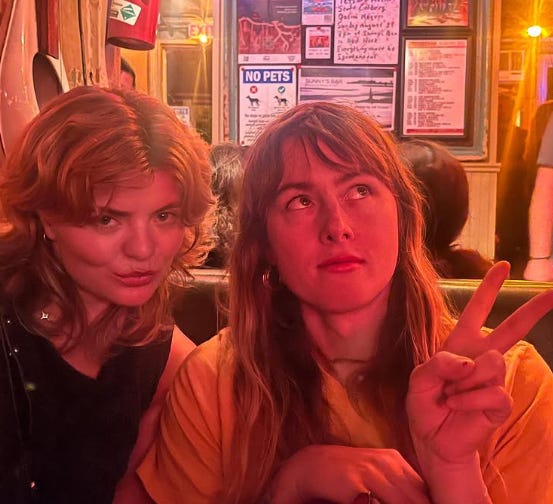
How do you complement each other’s skillsets as a team?
WSH: I love computer. And I love wire. And I love making thing work. And I’m really bad at money and negotiating and producing.
LCP: I’m good at negotiating and setting up the LLC bank accounts.
WSH: And then we hype each other up creatively.
LCP: And often in the mixing room, Wren will re-record a mix and I’ll effects edit.
Every project is different, but what should people expect in terms of the time and budget it generally takes?
