


Nothing Bogus is funded by its readers. To support this work, please consider upgrading from a free subscription to a paid one. For only $5/month or $50/year, you’ll get access to all content + the sublime high that comes from supporting independent arts journalism. Sharing the newsletter also goes a long way.
Obsession is officially Focus Features’ highest grossing film. And Backrooms is A24’s. There have been a million pieces reporting or musing on Hollywood’s hunt to find the next wunderYouTubekind. It certainly helps to have a loyal internet fanbase to tap into when it comes time to roll out a feature. But given how much Obsession in particular has grown week over week, I’m skeptical that these directors’ online followings are truly powering these phenomenons. (That seems more the case with Iron Lung, which grossed a fraction of the Obsession and Backrooms box offices.)
Earlier this year, I investigated how cinematic sensations happen, publishing a series of Q&As plus a longer article for Esquire (salacious headlines not mine). It was both an illuminating and frustrating reporting process. Lots of people had smart insights but ultimately it seemed like everyone was mostly grasping at straws. It was easy to draw through lines connecting different successes. But plenty of failures seemed to follow similar playbooks, and yet just never took off.
In that way, I’d think more companies would employ some version of a spray-and-pray strategy, producing a bunch of bold, low budget efforts, seeing what produces the most visceral audience reactions, and then sinking lots of marketing into a few of those films. Easier said than done, sure. And you’d probably need more capital than most of these companies have, yeah. But on the flip side, it seems like so many companies are just treading water. Big company consolidation is obviously a disaster for the business. But I do wonder if there would be benefits to some of the smaller companies joining forces. What do you think?
Here’s what’s happening this week:
Apply for Film Independent Fast Track by EOD today.
Apply for SFFilm documentary film fund by tmrw.
Sundance documentary fund deadline is also tmrw.
NYC/Upstate folk horror feature Blood Shine finishes a long festival run this month at Chattanooga Film Festival on June 21st. Directed by Emily Bennett and Justin Brooks, this twisted love story releases later this year. The film stars Brenden Sexton III (Welcome to the Dollhouse, Session 9), David Call (Insidious: The Red Door), Larry Fessenden (Killers of the Flower Moon), Toby Poser (Hellbender) and Bennett herself (Shelby Oaks).
On June 13, at 7:00 PM, join DarkRoom at the Film-Makers’ Coop for rarely screened 16mm experimental films. The program will end with a live score by Hollywood Extras. Tickets are $15 and can be purchased here.
Slamdance screenplay competition deadline is June 22.
Ten states are considering blocking the Paramount-Warner Bros. merger. Keep encouraging them!
So far at Tribeca, I’ve seen Human Theories and She Keeps Me Young. What’s the best thing you’ve seen at the festival so far apart from those films? Email nothingbogus1@gmail.com with recs.
Week one of film friends pick-up soccer in the park was a blast. Sign up here to play this week and in future weeks.
If you live in a city outside of NY/LA, please fill out this survey! Especially if you live in (or have lived in) MIAMI!!!
The Knicks are a movie! New York hasn’t felt like this since Biden’s election.
If you would like to list in a future issue, email nothingbogus1@gmail.com with the subject “Listing.” (It’s FREE!) Include your email and all relevant details (price, dates, etc.)
STRIKE THE CAMERA
Is the Stage the Best Place to Develop a Feature?
When Allie Avital adapted her unproduced feature as a play, the benefits went beyond her expectations.
by Allie Avital
Adapting my upcoming feature film The Naked Woman into a stage play has felt a little like discovering a cheat code. When I first decided to do it, I thought of the play primarily as a way to introduce audiences to the world of the film. What I didn’t expect was how much it would teach me about the film itself. Days before opening night, I already feel like I’ve cracked open the world of the film and lived inside it.
A bit about the show itself: The Naked Woman unfolds over a winter holiday in an Upstate New York country house, where a family of Soviet immigrants gathers to celebrate Misha, a man who has built a life on achievement, intelligence, and survival, until a single moment shatters the illusion. As the incident seeps into the house, the lively family gathering turns into a Chekhovian moral reckoning. It was inspired by a similar incident that occurred in my family, which sparked a decade-long writing process and brought us to this moment.
The stage is great for distilling a piece to its essence. Anything redundant, false, or extraneous quickly gets exposed. Something either breathes or it doesn’t. The merciless dark void of theatre demands truth and meaning, with no close-up shot or elaborate camera move to seduce you away from the heart of the story.
Growing up with a set designer father, I spent much of my childhood in theaters around New York City. On the surface, coming back to theatre after fifteen years in film comes with a learning curve. The language of aspect ratios, apple boxes, and bro-y film slang has given way to the endless mystery of stage left versus stage right, upstage versus downstage, and constantly reminding myself not to say “action” when we begin a run-through, or worse, “cut.” But as far as I’m concerned, the assignment is the same: create a compelling, cohesive structure of actions and feelings, and communicate them to an audience.
A few weeks ago in play rehearsals, an actor looked up from a scene and said, “I don’t feel it.” My cowriter, Alia Azamat Ashkenazi, and I stared at the page for a moment, cut a few lines, and suddenly the scene worked. That has happened over and over again. Entire scenes that survived draft after draft have collapsed within seconds once they’re on their feet. Tiny moments we barely noticed while writing have suddenly become the center of the story. A gesture. A glance. A hesitation before a line. Things that seemed insignificant on the page have revealed themselves to be essential. Since rehearsals began, we’ve revised both scripts in tandem, moving back and forth between screenplay and stage script.
To have actors not just reading our lines (as in a table read) but embodying them fully has been like a built-in bullshit-ometer. The immediacy of theater doesn’t allow for spackling. If a song cue fails, the audience sits in silence. If a moment isn’t landing, everyone in the room knows it. There’s beauty and terror in that.
In theater, rehearsal is the medium — the living raw material, not merely a path toward a finished product. It’s a completely different philosophy: the process is god.
That mindset will be something I carry with me into the film, when we make it, no matter how much rehearsal we get. The exploratory process in film is of course a huge luxury, but what I’ve learned is that all the physical and emotional exercises reap enormous rewards. Having our characters embody aspects of their natures (“sensitive,” “passionate,” “mischievous,” “impulsive,” “ruthless”), instructing them to stare into one another’s eyes for many uncomfortable minutes, having them act out their back story (“how you would play as 5 year olds”and then “the moment in high school you first first slept together”) all add depth, dimension, and subtle nuance to the scenes. Even if I’m only able to spend half an hour on these sorts of exercises during film prep, it will be an invaluable tool in my repertoire.
The blocking, which is of course more exaggerated and designed for the scale and perspective of a stage, is similarly helping create shapes for the film. Just today in rehearsal, seeing how our mother character held her daughter sent chills down my spine. I know I’ll recreate that physicality eventually on camera, and I know it will work.
Everyone who has made a film knows that when you’re locked in, when you’re in the world of the story, the themes of your film start showing up all around you: on set, in your personal life, amongst the actors and crew. In theatre, this has felt even more acute. In our particular story, the themes of death, blind devotion, and cross-cultural divides have played out amongst all of us in tangible ways, day to day. The feelings of shame, abandonment, and rage have surfaced amongst cast and crew. Lines of dialogue have been uttered, almost verbatim, completely unconsciously between us.
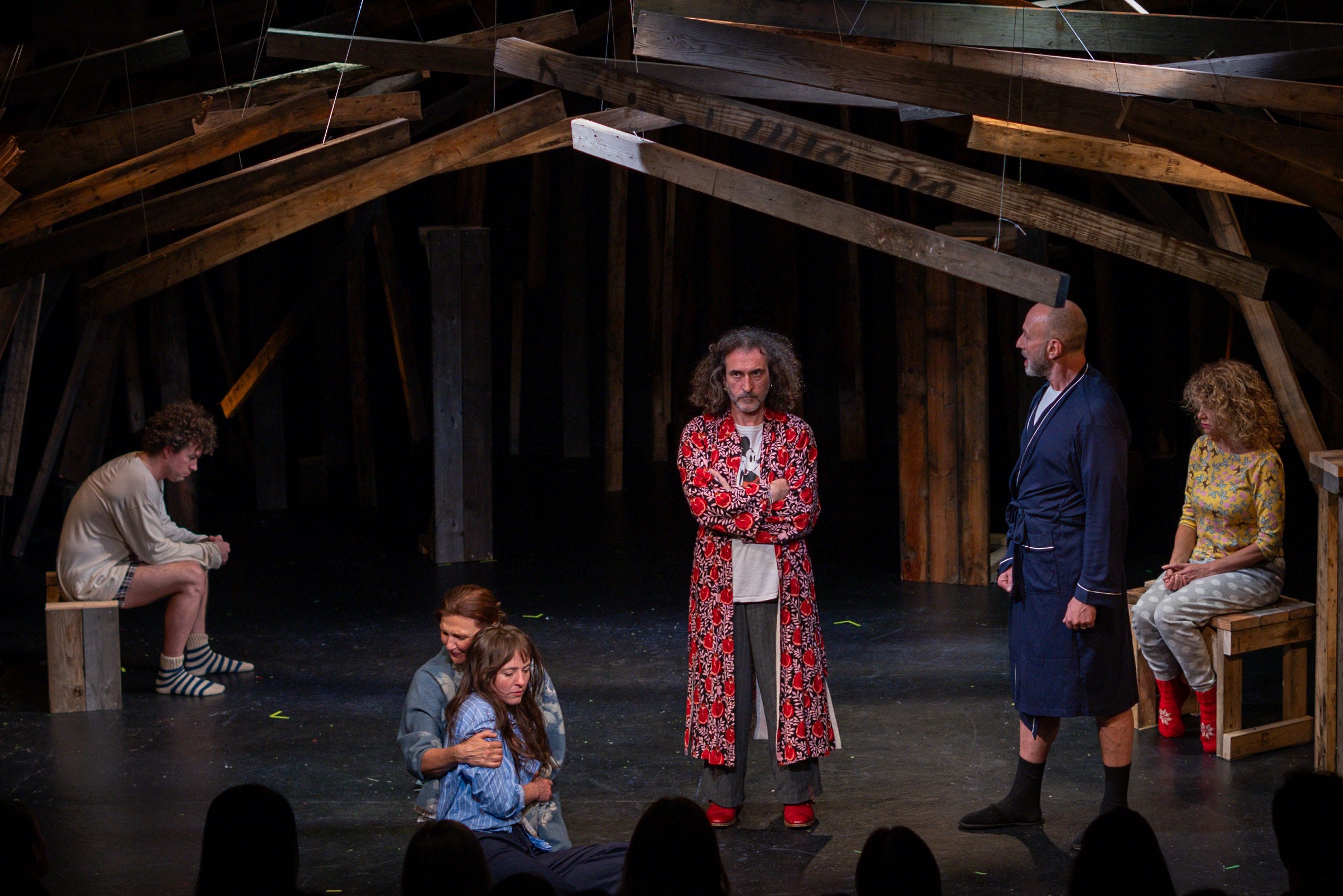
As a director, I find myself confronting many of the same questions as the characters. My anxieties about what kind of actress should play the lead (who is vaguely based on me), my shame around not spending enough time with my toddler while I’m in full-day rehearsals, even my nervousness about my father seeing a play loosely inspired by my family, all seem to echo emotional currents already present in the script. In a way, I’m getting a preview of this disorienting, all-consuming, existential rupture that all real artmaking seems to bring up in us all.
By the time we shoot the film, it won’t feel like I’m entering the world of the story. I’ll already have been living there. I can see what works, what parts make people laugh, and what dialogue still needs refinement. Obviously, not every film can — or should — be adapted first into a play. As a pre-production exercise, it’s certainly inefficient. But if you want to become a better film director — and if you want to learn new things about the piece and directing — I’d highly recommend it.
Director and writer Allie Avital is a prolific New York City filmmaker who has collaborated with global icons ranging from Lionel Messi and Dolly Parton to Olivia Rodrigo, the Yeah Yeah Yeahs, and Caroline Polachek. A nine-time Vimeo Staff Pick alumnus, Avital’s work has screened at Sundance, SXSW, and BAM. She previously directed the second unit on the MGM/Amazon film Holland starring Nicole Kidman, and co-wrote the 2026 ballet thriller Prima starring Faye Dunaway and Mira Sorvino. Her short film The Naked Woman won the Audience Award on Short of the Week, and the feature iteration is in early preproduction.
The Naked Woman runs from June 3-14th at Theatre 154 in the West Village. Tickets here.


