


Nothing Bogus is funded by its readers. To support this work, please consider upgrading from a free subscription to a paid one. For only $5/month or $50/year, you’ll get access to all content + the sublime high that comes from supporting independent arts journalism. Sharing the newsletter also goes a long way.
Last week, I was one of the thousands of people who saw You Can See Everything and immediately proclaimed it the film of the moment1. In part, that designation comes from the way it sweeps you off your feet, sustaining a sense of awe that is rare in today’s cinema. Over the course of its three hour runtime, the film is full of many surprising turns, and it seamlessly elicits a full spectrum of emotions — aided tremendously by the top tier, expertly employed craftsmanship of editor Adam Locke-Norton, cinematographer David Bolen, and composer Ari Balouzian. I left feeling high, but also in a daze, eager to interpret different critical moments, the filmmakers’ and participants’ intent, and what it all adds up to.
As a massive nonfiction phenomenon that different people are interpreting differently, what this reminds me of most is Serial. But whereas most of the Serial discourse revolved around the simple question of whodunnit, Elizabeth Holmes’s criminality is among the least interesting aspects of You Can See Everything. This isn’t a story about facts so much as it’s one about human psychology — about how it is malleable, full of contradictions, and ultimately unknowable to others and even to ourselves. There are plenty of narrative and nonfiction films alike about the slipperiness of perception. But what’s so intriguing — and of the moment — here is the different ways you can see people’s experiences and actions mediated by life online and the priorities of modern American culture. When Billy Evans lashes out at the figure who makes a surprise second half appearance, is he exposing his true self? Or is his hostility an aberration influenced by an online world that encourages combativeness? And at what point does a series of actions just become who we are?
At the core of the divisiveness of the past decade or two is an urge to flatten other people, and from there to form judgements. We all think we know so much. In different ways, all of Lance Oppenheim’s documentary work tangles with the subjectivity of truth. But whose version of the truth wins out? For You Can See Everything to be released just a month after Primetime — a narrative film based on the life of a real person, who feels misrepresented by the film’s depiction — only adds to the film’s resonance. No one is innocent. To live is to interpret. Still, I’d argue there’s a meaningful difference between acting in good faith and not. Reactions that are defensive or self-serving are natural. Transcending those urges is what people are meant to be talking about when they talk about “doing the work.”
There are a few truly shocking moments in You Can See Everything, but what shocked me most was the film’s empathy. Without ever treating its subjects with credulity, it conveys how complicated we all are — how we’re constantly both manipulating and being manipulated2. That word — “manipulate” — is full of negative connotations. But one of the things I found most inspiring about the film is the way Oppenheim and Nathan Fielder, as co-directors, exert their influence on each other. I’ve heard different people give authorial credit to one of them more than the other. But that tendency misses A) the obvious way each of their signatures are all over this thing, and B) the point of the movie. No one’s acting in a vacuum; every individual’s perception is limited.
Congrats to the whole team! Well done.
Here’s what’s happening this week:
Life World is hosting a Halloween party and scary show on October 31 at 9:00 PM. $10.
Submissions are open for Rooftop Films’s 2027 summer series. Early bird deadline is November 17.
Lost Cause (a film by Adam Kritzer) just launched a crowdfunding campaign to support its 2027 NYC theatrical release. The art-pop meta-musical asks how we can engage with people whose view we find abhorrent, if at all, and what we’re left to do when things don’t go as planned. Learn more and join the cause here.
If you’re a filmmaker/film worker living in a city OTHER THAN NYC/LA/Baltimore/South Florida, please please please fill out this quick survey and be part of a future Nothing Bogus article (like this and this) about the state of different cities’ film scenes.
Film Independent will produce alongside five U.S.-based director/producer teams to create short films that celebrate “the vital roles and contributions of seniors and explore the issues affecting them today.” Each selected project will have a $100,000 all-in production budget, and support with development, production, post-production, marketing and distribution. Apply here by October 26.
Non Films has a new DarkRoom screening and salon at Freddy’s Tuesday October 27.
Adult Film NYC is hosting a two day workshop on intuitive acting with Maria Dizzia. 11:00 AM - 4:00 PM, $250. Email adultfilm@gmail.com.
This is the venn diagram of Digger super fans and over 60 Bernie bros who are legendary artists.
If you would like to list in a future issue, email nothingbogus1@gmail.com with the subject “Listing.” (It’s FREE!) Include your email and all relevant details (price, dates, etc.)
RELEASE DIARIES
Festivals and Vimeo Are Not the Be-All End-All for Shorts
How a DIY tour of a short film can be a pathway to deeper connection.
by Peter Coccoma
I was in the bathroom of a small theater in rural Maine, following the last screening of the five city tour of my short film, when I felt something I hadn’t in a while. After the exhaustion of the shoot and the self-doubt of watching early cuts, I was feeling love for my collaborators and the heart-warming generosity of others welcoming a group of filmmakers into their community.
Six months prior, reaching audiences in a meaningful way was not something that seemed like an option. But the tour I embarked on made me feel that growing a culture of touring films could be one alternative to all the dispiriting realities of film distribution today.
***
Coming to the concept for this tour was a bit of an experiment. The process of making the film with a group of collaborators had been so fortifying. But like many filmmakers, I’d put so much attention into making the work itself that by the time it was ready to share I was exhausted and unsure of what to do with it. Looking at the only two options for short film distribution — the oversaturated festival circuit and the impersonal online release — I felt little possibility of screening the film in a way that could form a personal connection with audiences.
My short, Drifts, is about a photographer nearing middle age and struggling with depression — having lost her passion for her craft to the hollowness that can come from trying to survive and make a life around art. On a camping trip, she has a chance encounter with a father and son, and their unique way of being in the world reminds her of that feeling she’s lost touch with. I love filmmaking, but like the character, I was depleted. And the lack of control over the distribution process added to my confusion and left me searching for a way to not give into the disheartening feelings. Before I ever started making films, I spent years doing DIY tours with bands, so I wondered, Maybe I could tour my film like a band?
***
Touring a short won’t be right for every film, but there were things about Drifts that made it a good fit. It’s long for a short (20 minutes), contemplative in tone, and has a narrative structure and pace that people told me feels like a “mini-feature.” But even a long short film is not enough to tour on its own. So I needed to find a way to expand Drifts into a longer performance. I asked myself: What is the mood of the film and how can I extend that beyond the screen?
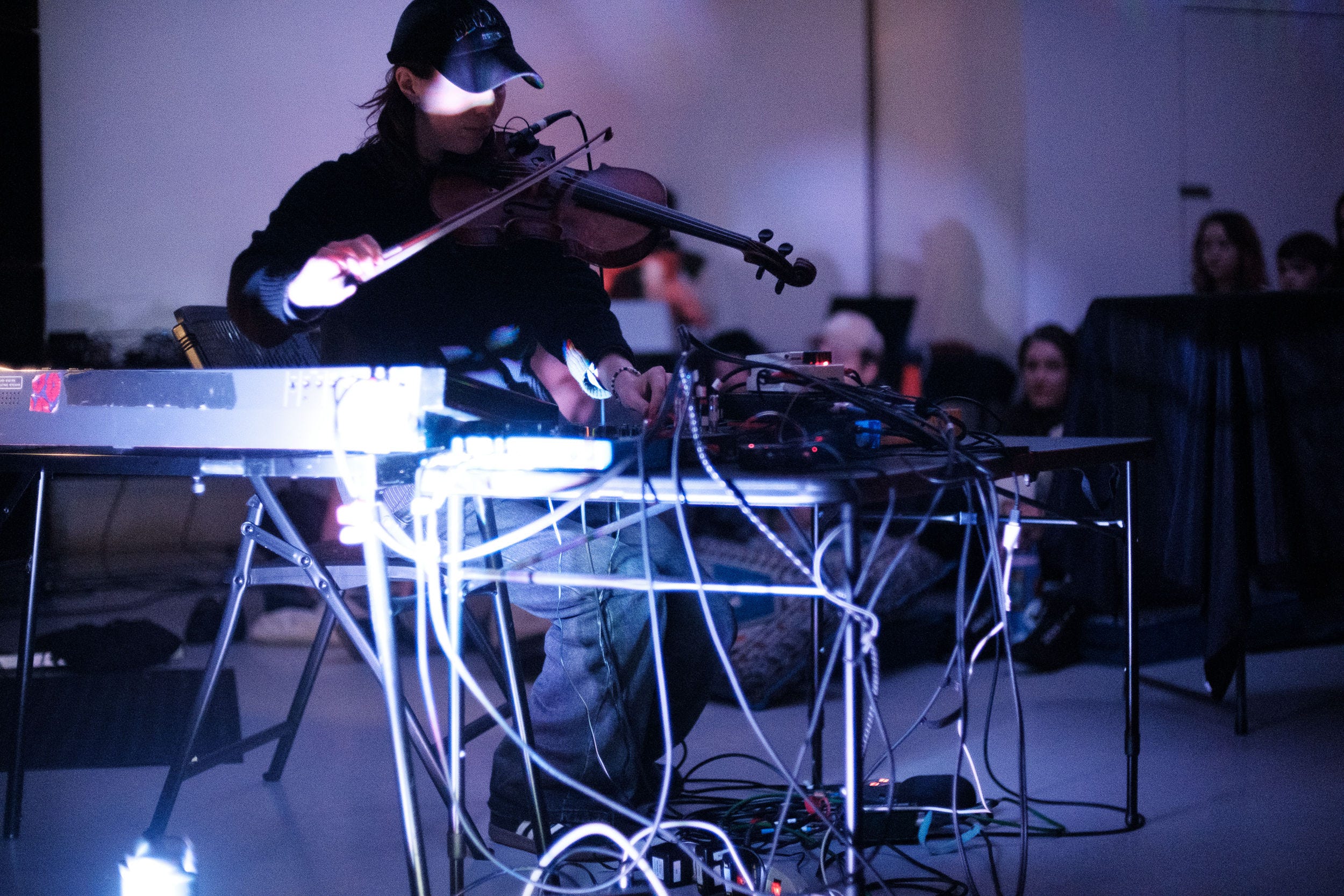
For Drifts, with its subtle, atmospheric storytelling, I wanted people to tune in to their surroundings, and that meant calming their nervous systems down from the anxious internet-brain that most of us take into the theater. So I thought: What if the film’s composer, Elori Saxl, expanded the score into a performance of its own that would be something of a prelude to the film? She ended up writing a whole new set of music inspired by the score, so that by the time the first frame played, the whole audience would already be living in the world of Drifts.
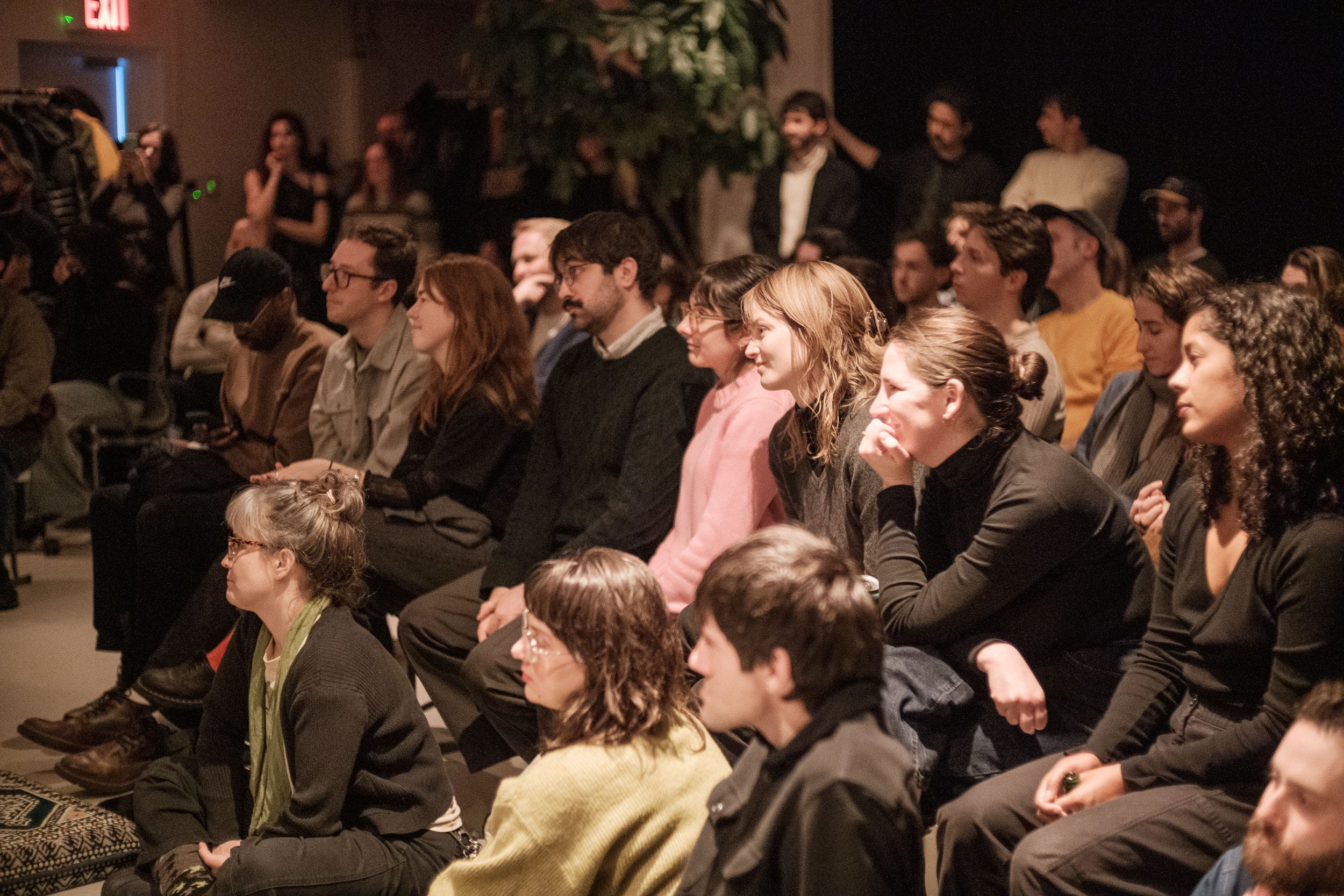
Our first screening was in NYC because much of the cast and crew lived there. We screened at a friend’s studio space to a full room. Multiple members of the cast and crew joined me for the Q&A, a friend DJ’d afterwards, and we all got to spend the evening in the headspace of Drifts. Afterwards, cast, crew, and audience members all told me how special it was to have the film presented this way. It felt like the screening experience reflected the themes of the film and how much time and heart we’d all put into making it. I didn’t think what I was doing was anything special, but a few filmmakers asked how they could do something similar. I could see in them something I knew well: a desire for some other way to connect with audiences.
***
Touring a short film isn’t a new idea. But what was liberating for me was not having to stick to the rules of what a screening can be. Shorts are a place for experimentation, so maybe we need to experiment more with how we screen them. If your film is a comedy, you could have different local stand-ups open each night. Or maybe you made a techno rage thriller and you screen it at a club where everyone can thrash to a 180bpm set after the credits roll. One of my favorite screenings of our tour was at a bathhouse in Portland, ME, because the environment of the venue — one where people are used to sinking into stillness — matched so well with the tone of the film.
One of the things I learned early when touring in a band is that booking a show in Kansas City doesn’t mean people will show up. And the feeling of playing to nobody but the sound person is… not great for finding connection. It’s not about the number of cities, or how big the venue is. A room that fits 40 with 25 people in it feels great, a room that fits 200 with 25 feels bad. Great house shows have been some of my favorite memories playing music. Having the means to get around can be difficult when you’re working multiple jobs on top of making films, so I planned screenings around travel plans I already had — even spreading it out over many months — to make it more feasible.
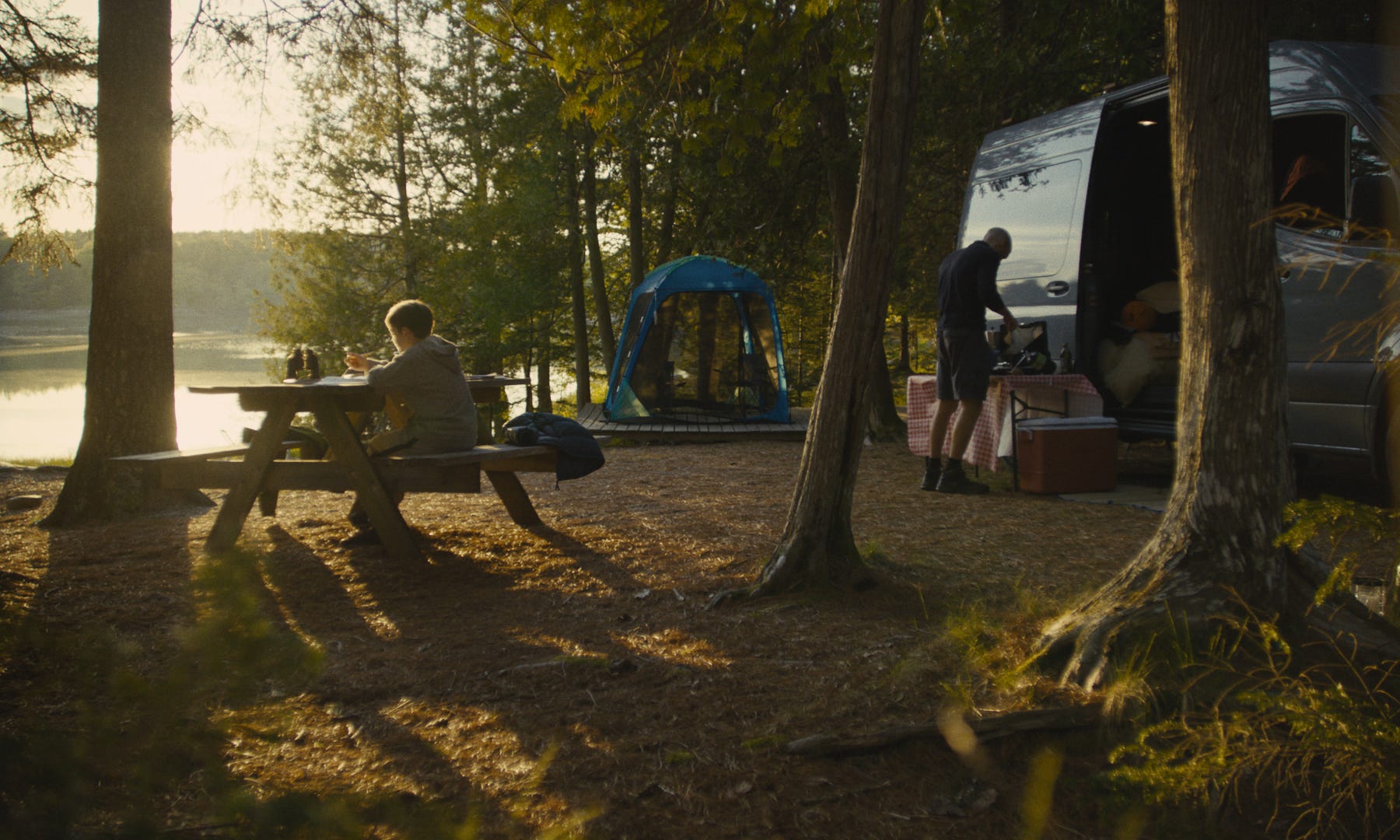
Another thing I learned touring in bands: Talk to other people who’ve recently done it. Where’d you play? What was that venue like? How was the turnout? Keep your past screening dates listed publicly (mine are here) so others can find them. It’s work, but make it part of building community around films. Introduce like-minded filmmakers to a screening spot in your town, moderate their Q&A, tell your friends to come, let them stay with you. There’s a special bond that comes from crashing with other bands or putting them up in your town. Maybe if more people take this path we can create a network of venues and audiences that can make touring a short more feasible for the next person.
The most important thing I learned, though, was simple: Put your heart into it. A lot of “eventizing” gets talked about as “advertising” for the film. Yes, filmmakers need to understand marketing (especially at feature level budgets), but we also have to protect what cinema is really about, or it’s going to feel more and more like commercials. I tried to bring to the release that same care and attention to detail I brought to making the film. I kept reminding myself that creating an evening around a film, one that really connects you and your audience and the work, is the thing itself. Making it personal and handmade gave audiences the chance to find their own way in — and I got a lot back in the process. Years of touring with bands had real ups and downs, but at its best it reminded me that we’re all hungry for opportunities to be together and share in our emotional lives.
***
After NYC we screened in Hudson, NY, where one of our producers, Meg Murnane, helped set up a show at an art gallery. I live in the area, and screening for your hometown community can provide a lot of big feelings and remind you that touring doesn’t have to be somewhere far away. Months later, hanging out after a screening in LA that our other producer Breanne Thomas helped set up, two film composer friends, Celia Hollander and Ben Babbit, remarked how great it was for the film’s composer to play a whole set of music before the film, how it really heightened your awareness of sound that continued through watching the film. It made me think this kind of expanded cinema isn’t just for shorts. Imagine Cecilia Hollander playing a set of her music to get you in the mood before Good One. Or Ben Babbit creating a soundscape before My First Film. Those are unique experiences I’d love to be in the room for.
After the last screening in the small town in Maine where we’d filmed, one of the local kids I had street-cast in his first film role came up to tell me how exciting it was to see the film screened at his local theater. Then he turned to me and said, “I want to keep acting. I want to make films. How do I do more of this?” Everything felt so human to human in that moment. It was a moving reminder of the direct way films can affect people. And in the bathroom afterwards I felt in my body those feelings from my own childhood, growing up in my own small town where that rare opportunity of encountering art that spoke to something in me had made me ask: What is this and how do I make a life around it?
***
There are so many things in our culture, economy, and political discourse that drain us of our passions for making and experiencing art. And as corporations and private equity further their consolidation of the film industry around recycled IP and streaming, how do we reclaim screening films as a pathway to waking up from the noise? How can it be a way to break free of the disenchantment that comes with modern life?
Maybe touring short films can be one part of a new ecosystem that’s emerging around these questions. Maybe DIY film touring can be an antidote to all the disconnection in our lives.
Peter Coccoma is a filmmaker and musician. His debut solo experimental electronic album, A Place To Begin, was named as one of NPR’s Best Albums of the Year. His short film, Jeano, was commissioned by Smithsonian Folkways, and it’s follow up, Giro Prepares for Death, screened at festivals around the country. Drifts, his newest short, recently toured as an expanded performance with composer Elori Saxl. He is currently developing his debut feature and planning the release of his next record.
See also:


“Decade” is the word I used, but I’ve also seen “year” and “century” used frequently.
Another movie I’ve been thinking about a lot in connection to You Can See Everything is May December.
You: “At the core of the divisiveness of the past decade or two is an urge to flatten other people, and from there to form judgements.”
Me: I so agree!
Robert Bly referred to this as the great flattening in his underrated book, The Sibling Society. Its purpose to diminish hierarchy. IMHO, in our super inequality ridden society, while it’s nearly impossible to “flatten” the real aristocracy of our times (Musk, Bezos, and every other oligarch) we misplace our flattening lasers and train them onto everyone else. And it just gets ugly.
Interesting to me that “You Can See Everything” is outperforming “Musk” by a lot. There are, of course, lots of reasons for this. But at its core there might be the audience’s desire to see a previously untouchable billionaire get flattened, while “Musk” just underscores inequality, and our age of impunity.