

On the Power of Texture
Filmmaker Aidan Cronin on experimental techniques, formative collaborations, and founding the Ithaca Experimental Film Festival.


Sundance ‘26 wrapped yesterday. Much has been made of the all-night marathon bidding war for Olivia Wilde’s new comedy, The Invite. The film, which stars Seth Rogen, Ed Norton, Penelope Cruz, and Wilde, reportedly sold to A24 for $12 million. That there was a decent market for what seems to be a broadly entertaining film with a star-studded cast and Annapurna’s backing is, of course, better than the alternative. But I’m not sure it says much about the current state of the independent market. What of everything that was made, shall we say, more independently?
Levictus, the Australian queer horror film from Adrian Chiarella, reportedly sold to Neon for seven figures. And Sony Pictures Classics picked up a couple of (*gasp*) dramas: Josef Kubota Wladyka’s Ha-Chan, Shake Your Booty! and Stephanie Ahn’s debut, Bedford Park. No word on how much either went for or what the deals looked like, but it’s cool that Sony Pictures Classics came out swinging.
As for awards, the Grand Jury Prizes went to Josephine (U.S. Dramatic Competition), Nuisance Bear (U.S. Documentary Competition), Shame and Money (World Cinema Dramatic Competition), and To Hold a Mountain (World Cinema Documentary Competition). The NEXT Innovator Award went to The Incomer, and the NEXT Special Jury Award went to TheyDream.
Here’s what else is happening this week:
If you haven’t done so yet, sign the pledge to boycott Enterprise and its subsidiary brands National and Alamo for providing vehicles to ICE.
According to a friend on the ground in Minnesota, ICE “purposefully ram their vehicles into other cars and leave the victims' vehicles in the middle of the road (sometimes still running or not even in park), they switch plates or drive with no plates at all to avoid tracking and accountability, they drive on the wrong side of the road, and they far exceed the speed limit constantly.”
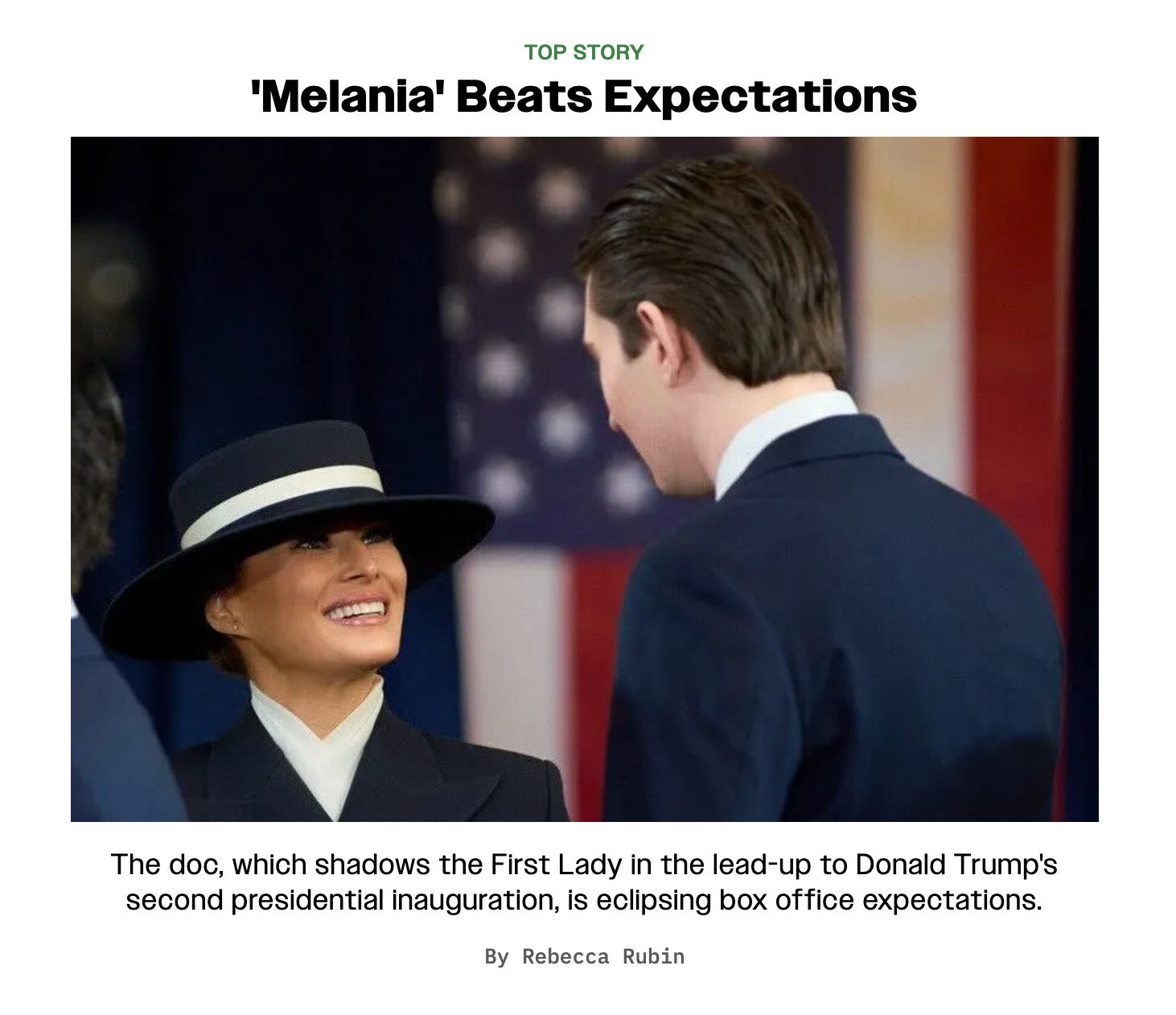
Shame on all the trades writing adulatory headlines on the ‘success’ of Melania’s opening weekend. These are the same clowns who can’t shut up about the Sinners and One Battle box offices not being that great when you consider their budgets and marketing spends. Do you realize how much Amazon spent marketing this craven propaganda?!? Grow a spine, people.
UFO Short Film Lab applications close at the end of the day today. Get them in now for a chance to receive $10K, mentorship, and in-kind production/post resources.
The Sundance Producer’s Lab is accepting applications through Feb 11 at 9:00 AM PT. More here.
Stella Tompkins is casting an A24 film that’s looking for a male body builder/mma/self help guru type (40s - 50s). DM @stellatompkins on IG if that’s you or someone you know.
Jesse Zhou has a full video and sound kit and will shoot and edit for cheap for those looking for content for a business, brand, etc. DM @fml.jesse on IG.
Chris Amaya is seeking extras for a short film/pilot shooting 2/3 in the evening. Food provided. Shoot is at a Brooklyn diner. DM @tatamidreams_ on IG.
Are you an experienced horror director (ideally Asian) who wants to shoot a $1m feature in Q3 of this year? Email materials to hi@thomaspk.com.
I liked this review of Union County from sam bodrojan. If you don’t follow her substack, you should.
If you’re a filmmaker living in BALTIMORE, please please please fill out this quick survey and be part of a future Nothing Bogus article about the state of different cities’ film scenes.
And RIP to the great Catherine O’Hara, a truly one-of-one comedic genius.
If you would like to list in a future issue, either A) post in the Nothing Bogus chat thread, or B) email nothingbogus1@gmail.com with the subject “Listing.” (It’s FREE!) Include your email and all relevant details (price, dates, etc.)
THE FEATURE PRESENTATION
Exploring Texture and Memory with Aidan Cronin
Non Films’ Brian Ratigan and filmmaker Aidan Cronin discuss experimental techniques, formative collaborations, and Ithaca Experimental Film Festival.

by Brian Ratigan
When I first met Aidan Cronin, it felt like we had known each other for ages. At the time, Aidan was developing what would become his first feature film, The Birds Tell Me All There is to Know. We shared similar film influences and interests, and both gravitated to those that are taking actual risks in their filmmaking, whether shooting on expired stock or adapting from poetic source materials.
After graduating from Ithaca College, Aidan crafted and collaborated on numerous short films (including Philip Thompson’s I’m at Home and Living Reality), launched the Ithaca Experimental Film Festival at his alma mater, and became a festival programmer at the Brooklyn Film Festival. I recently met up with him in Prospect Park to talk about his origins as a filmmaker, his upcoming debut feature, and the act of looking.
Brian Ratigan: What was your first introduction to filmmaking?
Aidan Cronin: I remember when I was about six, I went to the Coney Island Aquarium with my grandparents. My aunt and uncle had three disposable cameras, and I just remember I took one from them, and started rifling off photos. Everywhere I looked, I was like “This needs to be captured. Oh, this needs to be captured.” So there was always this need to document.
In late middle school I would make little comedy videos with my friends. We went to thrift shops and eventually found a VHS camera. In my friend’s basement — it was all wood-paneled walls with a VCR player and a little TV — we started making these movies. And we would shoot them on VHS, so we couldn’t edit anything. It all had to be done in one continuous take. We would sit around and watch the things we had just made, and it felt so much better than just shooting something on your iPhone and playing it back. It felt like you were really creating something.
In high school, I did a lot of 35mm street photography and continued making movies. My whole life, I would just watch movies by myself. Freshman year at Ithaca College, I met the people I still make films with now, such as Desirée Tolchin and Philip Thompson.


BR: How else did you develop at Ithaca College?
AC: I discovered 16mm studying under my professor, Brad Rappa, and I made a comedy movie called Macaroni Serenade. You can’t sync sound on the Bolex, but I was doing everything else: directing, cinematography, acting, and then I ADR’d the whole thing afterwards. So I’ve always made things way more difficult than they need to be. I had tried shooting things on digital and I had no restraint — I would just roll. There was something that just drew me to shooting on film and 16mm with all these restrictions. It was the ephemerality of it or the tactile nature of a physical print or object. Just like with VHS, I want to hold it, I want to see the imperfections.
I had another professor in college named Joshua Bonnetta, and my big takeaway from his class was to “synthesize your project through other mediums,” which was something I never even thought to do prior to that. This led me to start painting, making music, and writing poetry as ways of exploring the emotions surrounding a film from another perspective, which in turn pushed me to experiment with film imagery and how I told and visualized stories.
BR: So how did these instructions make their way into film collaboration?
AC: I met Phil Thompson at summer orientation. You’d have screening for first semester projects and you’d see who was making films that you really liked. People would just talk and talk about working together on something, so it was naturally collaborative. I feel a lot like what I was doing before was just wearing every hat: doing the sound as I was directing, etc. So there was something nice about shooting other people’s work, where I’m just focused on the compositions, and the feeling and the light. Then you’re just drawn to working with cool people. You have 2:00 AM conversations and it’s like, “You’re interested in thinking about things. Let me help you make something cool that you want to make.”
I started writing a lot of poetry and began developing my early films in college. There is a Hole in the Ground and I Don’t Fight the Dark as Well as I Used To both started as poems. They were very locked down and observational. Those films are mostly older people kind of at the tail end of their life, reflecting a lot, and then also being anxious about what’s about to come. I worked with cinematographer Akesh Patel on those movies, and Jack Liden always did sound.
Desirée Tolchin and I had been living together for about two years, and she would carry around a super eight camera and just capture moments that were happening in our life with our friends and her family. I think I might have shot one or two frames, but she shot the vast majority of what became Visions of Waves. She had it all scanned and edited but didn’t really know what to do with it. She showed it to me and I was like “Oh my god. This is great. Keep going.” I really wanted to do sound design or make a little composition for it, and by doing so I think that film really helped me grow in other avenues. I guess I was being emotionally conscious as I was writing that into the movie.
BR: And all of you continued to collaborate on each other’s films?
AC: I had been working with Phil a lot on his film, I’m At Home, where he plays this kids TV show host who kind of spins off. The cinematography of that film is intended to make the images feel like they’re in the past tense, like they’ve been sitting on someone’s hard drive forever. So in playing around with different analog textures and scanning, we tried to make it feel like it has its own anxieties and emotions in the activeness of the shadows and the color. We pushed the 16mm quite a few stops when developing the film to create this chaotic grain structure and muted color palette that reflected the character. Anxiety, texture, and there’s so many shadows in that film that are so active and moving like feeling it in that moment. You can recognize it a little bit subconsciously.
So continuing to explore ideas like that, we did another movie, Living Reality, that has more of a sitcom feel. We shot it on a church stage but we couldn’t afford studio cameras, so I bought three of these Canon XL-1s off eBay. The goal was to get this texture to feel like those weird, burned-in YouTube clips that someone’s recorded, then re-recorded, then re-re-recorded. To achieve that feel, we experimented with shooting it on Mini DV and then scanning it to VHS, digitizing, then going back again to VHS.
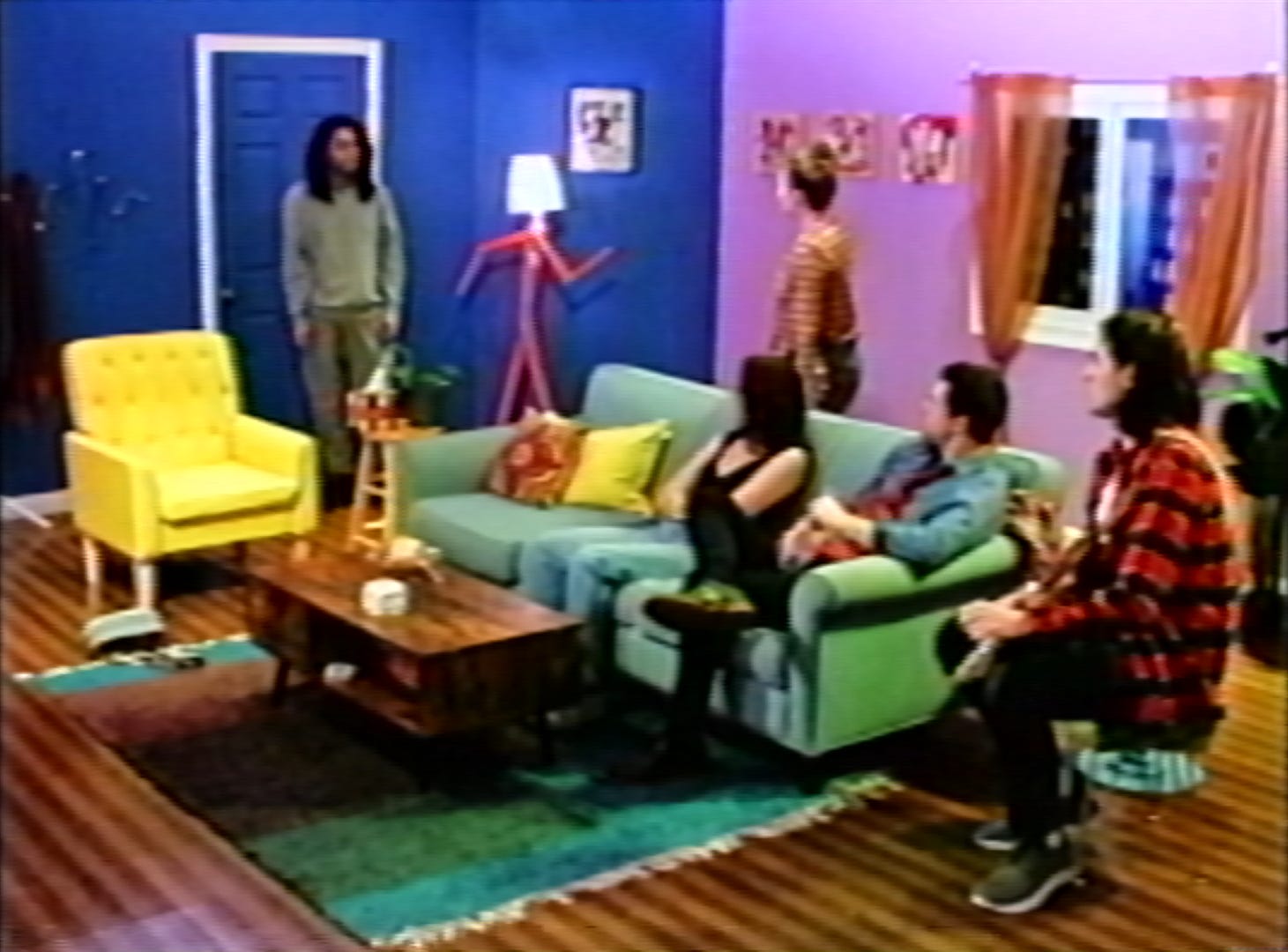
BR: How many times do you think you re-digitized in total?
AC: I broke the VCR, so we couldn’t do it too much, but I really want to do a film where it’s like completely near the last rung of information. We wanted to capture something in the real world that did feel like an impressionist painting, as if it’s emotion first and image second. A lot of the ideas just come from curiosity and a little bit of sleep deprivation. By researching camcorders, I was stumbling on these really intimate home movies that also had this visual quality of an awareness that it was fleeting. Even though you’re looking at a moment unfolding in-camera, present tense, there’s also an emotional weight that’s beautiful, but you know it depends on the moment.
BR: Can you talk a bit more about visual texture?
AC: I really wanted to explore that texture in a more locked down kind of way with my feature. I wanted to not have it feel like there’s a cameraman behind it. More from: let’s explore this texture as a texture, without the implication that someone is telling you where to look.
I found this guy on YouTube who would record his dog in a garden on this camera called the Sony TR640E, which is like a video 8 camera before high 8. The interesting thing about that camera is that the color really stayed. With later models, like high 8, they wanted to increase the quality, so they sucked a lot of color out. But those video 8 cameras have this really vibrant color that you’d see in a lot of home movies from the ‘80s and ‘90s. I also found this filmmaker that I would watch a bunch named Nelson Sullivan. He would make vlogs on VHS in the ‘80s. I loved the way he treated every passing moment, focusing on little things that most people would overlook.
BR: With shooting on these formats, how did everything build into you making a feature?
AC: I started inadvertently making a lot of films about my grandmother’s sickness through these different stories, which was a cathartic thing for me. My grandmother had Parkinson’s, and it was a long battle that got really bad near the end, when she was not really verbal. After she passed, my grandfather kept forgetting that she died, and that was kind of our introduction to his dementia. As a young man in my early twenties, I was looking at my grandparents — who I really admired — and both of their identities were kind of being stripped of them. That’s the genesis of my feature: I’m searching for my identity as a young man, and simultaneously theirs is being ripped away from them. So I’m exploring identity, mortality, and life’s purpose.
I’ve always been interested in capturing images as memories, or as things that aren’t happening in the present moment. When looking at a space or a moment, that is only ten percent of it. There’s like this ninety percent weight of what it feels like — what do you really remember from it? And I wanted to explore that in film, and I think I’ve found it a little bit by shooting on antiquated cameras. I’m fascinated by the little things that make us people — the little things that can elicit a memory or a feeling that we all share. I think all of that makes us feel a bit more connected.
BR: “Images as artifacts” or “images as memories.”
AC: I had written the script after I graduated college. It was about an old man with dementia who befriends a young woman grieving the loss of her father. My one grandfather without dementia is playing a version of my other grandfather who has dementia. And my parents are in the movie. My dad, who’s the son of my grandfather with dementia, plays the son of my other grandfather without dementia. In this movie, he’s kind of having the same conversations that he has with his real dad. So in a way, it’s all kind of an artifact of us together exploring this chapter of our lives, and I guess printing it on something physical to look back on: This is who we were and this was something we were feeling. It can sound overwhelming, like beauty and sadness in life, but in a very understated way.
BR: What’s next for your feature?
AC: Currently, just submitting to film festivals and awaiting a world premiere.
BR: Lastly, can you talk about the Ithaca Experimental Film Festival?
AC: So me and my collaborators, we all went to Ithaca College. When we graduated, we started submitting our thesis films to festivals. We were able to go to some really cool festivals and meet some really cool people, but mutually we thought, “Damn, if we had this when we were in college, this would be so helpful. This would be so sick.” Especially the parts where you’re talking with filmmakers who’ve been doing this for a while, and we’re all kind of interested in vulnerable storytelling and alternative forms of storytelling. We were really drawn to programming a lot of things with different visual aesthetics, people experimenting with antiquated cameras, and work shot on celluloid. From this, we decided to launch the Ithaca Experimental Film Festival in 2023.
This year, February 27 - 28, will be our third festival. The only criteria we’re looking for is an honest filmmaking voice, whether that comes in documentary, animation, experimental, or narrative. It really has informed a lot of our own filmmaking. We’ve had a whole other round of education in film by just watching such incredible things. Not only looking at them visually, but from the sound recording techniques and the structure of the way people tell stories.
Brian Ratigan is a filmmaker and festival programmer in NYC. He is the founder of Non Films and hosts monthly DarkRoom Screenings in various boroughs.
Though this issue of the newsletter was free, it would be great if you’d show your support by upgrading to a paid tier. It’s just $5 a month and goes a long way towards making this thing possible :)
Liking and sharing also is very helpful.
 | A guest post by
|
Couldn't agree more. The independent market often feels less organic, more like a structured algorithm dictated by major palyers.
Grow a spine indeed! $7 million for an opening weekend of a $40 million film, to say nothing of the approximate amount on the marketing budget? Hilarious!